Elizabeth Blaustein
Racine Journal Times, November 25, 1997
It could be called a comedy of errors, only the destruction caused by Racine’s Great Fire was anything but funny. Almost seven city blocks were burned to the ground, and hundreds of people lost their businesses and homes.
The fire started on May 6, 1882, in the Goodrich Transportation Co., an old, three-story warehouse at the west end of the city’s southern harbor pier. According to a chapter written by John Van Thiel in “The History of the Racine Fire Department,” sparks from a tugboat docked in the harbor blew into the warehouse and began smoldering.
People noticed smoke as early as 10 p.m., Van Thiel writes, but most of them ignored it. It wasn’t until 45 minutes later that a 12-year-old boy smelled smoke, woke his father and sounded the alarm.
The firemen first responding to the fire came too quickly: Their steamers did not have enough time to create steam pressure to project water. With no water, firefighters could only watch the fire grow.
“One fireman who fought the blaze remarked a year later, `If we had (had) a few barrels of water there at that time, we could have put it out,”‘ Van Thiel writes.
The fire spread quickly to lumberyards surrounding the warehouse. From there, wind and more bad luck kept the city burning. The fire devoured building after building, while Racine residents got out of the way and stood in the streets to watch.
All night Racine firefighters battled the flames. Departments from Milwaukee and Chicago traveled by train with their equipment to lend a hand. Then-mayor William Packard had issued telegraph after telegraph to the mayors of these cities pleading for help. When they did not show up, he sent one more desperate message to Milwaukee: “For God’s sake, where are the steamers we sent for?”
The anticipated help had fallen on bad luck, as well. Both departments had difficulty loading their steamers onto trains. Once Milwaukee’s equipment arrived, there was further delay when sparks from the locomotive started a small fire on one of the steamers.
The fire was not put out completely until 2 p.m. the next day. By that time, more than 70 stores, saloons, stables, homes, factories and other buildings had been burned to the ground. Remarkably, no one died in the fire although one woman did die after having a heart attack during the excitement.
Among the casualties of the fire were Porter’s furniture store and the famous Congress House hotel.
Here are a few of the other major fires that ravished Racine:
Racine’s first big fire broke out in a dry goods store on Main Street on Jan. 24, 1841. Racine residents battled the fire with anything that could hold water, but their efforts were not enough. The dry goods store, and the law office above it, were destroyed.
Early on Jan. 4, 1860, a fire started in a blacksmith shop on Fifth Street between Main Street and Wisconsin Avenue. The fire quickly spread west until it destroyed a paint shop, a wagon shop, Racine’s first hotel and Porter’s furniture. Called “The Big Fire,” it caused $160,000 in damage.
On May 1, 1862, a fire that originated in a shoe store ended up engulfing the church that sounded the fire alarm. The fire broke out in a shoe store just west of the First Baptist Church on Sixth Street. People nearby rang the church bell desperately, but firefighters did not arrive for more than an hour. By that time, the flames had reached the church. People continued to ring the bell until its rope caught fire and burned through.
Three people died in a fire that destroyed the majestic Blake Opera House on Dec. 27, 1884. The six-story opera house, at Sixth Street and College Avenue, exploded in flames late one night after a show. No one knew how the fire had started. Forty years later, a man who had worked there as a boy confessed to a friend before he died that he had left a candle burning.
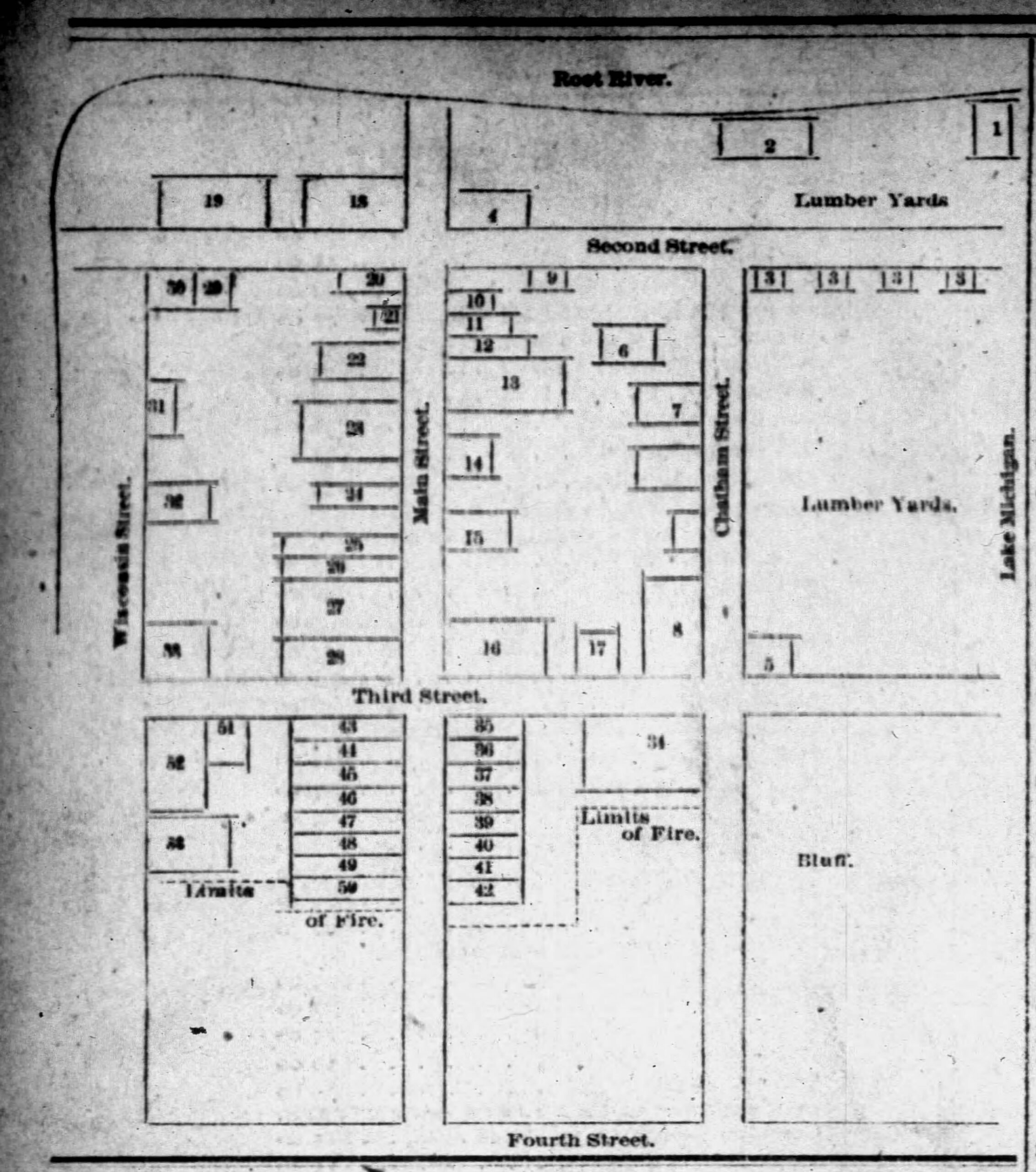
Index to the map of the Racine fire of May 5, 1882
Racine Daily Journal, May 6, 1882
- Goodrich Warehouse.
- Elevator.
- Lumber Offices.
- Silver Plate Factory.
- Frame Building.
- Philbrook’s Shoe Pac Factory.
- Boarding House.
- S. Miller & Co.
- Frame Dwelling.
- Denton’s Paint Shop.
- Engine House No. 2.
- Marble Hall.
- F. Ibling.
- S. Ryan.
- Frame Boarding House.
- Railroad Offices.
- Porter’s Cabinet Shop.
- Herzog & Roberts’ Flour Mill.
- Thos. Driver’s Planing Mill.
- Klapperth Shoe Store.
- Sam Hood’s Office.
- Farmers Home.
- Union Hall Block.
- F. X. Haas’ grocery.
- Hanson’s saloon.
- M. Keldel’s clothing store.
- W. A. Porter’s furniture store.
- F. Baumann’s hardware store.
- Tony Duffy’s saloon.
- Cary’s saloon.
- Frame dwelling houses.
- Brick dwelling.
- Frank Wright’s livery stables.
- Congress Hall.
- Kelley’s harness shop.
- Saloon.
- Sewing machine depot.
- Bakery.
- Mrs. Atkinson, millinery.
- Sutherland’s harness shop.
- Kammerer’s barber shop.
- Summer Garden.
- Schulze’s Drug Store.
- Heck’s Saloon.
- Havek’s Grocery Store.
- E. H. Brill Grocery Store.
- A. Kraupa’s Hardware Store.
- Kock’s Saloon.
- Hagen & Benning’s shoe store.
- Oslus, Hettrich & Co., dry goods.
- Frame dwelling house.
- Chas. Troy’s boarding house.
- Brick dwelling houses.