Elizabeth Blaustein
Racine Journal Times, November 25, 1997
It could be called a comedy of errors, only the destruction caused by Racine’s Great Fire was anything but funny. Almost seven city blocks were burned to the ground, and hundreds of people lost their businesses and homes.
The fire started on May 6, 1882, in the Goodrich Transportation Co., an old, three-story warehouse at the west end of the city’s southern harbor pier. According to a chapter written by John Van Thiel in “The History of the Racine Fire Department,” sparks from a tugboat docked in the harbor blew into the warehouse and began smoldering.
People noticed smoke as early as 10 p.m., Van Thiel writes, but most of them ignored it. It wasn’t until 45 minutes later that a 12-year-old boy smelled smoke, woke his father and sounded the alarm.
The firemen first responding to the fire came too quickly: Their steamers did not have enough time to create steam pressure to project water. With no water, firefighters could only watch the fire grow.
“One fireman who fought the blaze remarked a year later, `If we had (had) a few barrels of water there at that time, we could have put it out,”‘ Van Thiel writes.
The fire spread quickly to lumberyards surrounding the warehouse. From there, wind and more bad luck kept the city burning. The fire devoured building after building, while Racine residents got out of the way and stood in the streets to watch.
All night Racine firefighters battled the flames. Departments from Milwaukee and Chicago traveled by train with their equipment to lend a hand. Then-mayor William Packard had issued telegraph after telegraph to the mayors of these cities pleading for help. When they did not show up, he sent one more desperate message to Milwaukee: “For God’s sake, where are the steamers we sent for?”
The anticipated help had fallen on bad luck, as well. Both departments had difficulty loading their steamers onto trains. Once Milwaukee’s equipment arrived, there was further delay when sparks from the locomotive started a small fire on one of the steamers.
The fire was not put out completely until 2 p.m. the next day. By that time, more than 70 stores, saloons, stables, homes, factories and other buildings had been burned to the ground. Remarkably, no one died in the fire although one woman did die after having a heart attack during the excitement.
Among the casualties of the fire were Porter’s furniture store and the famous Congress House hotel.
Here are a few of the other major fires that ravished Racine:
Racine’s first big fire broke out in a dry goods store on Main Street on Jan. 24, 1841. Racine residents battled the fire with anything that could hold water, but their efforts were not enough. The dry goods store, and the law office above it, were destroyed.
Early on Jan. 4, 1860, a fire started in a blacksmith shop on Fifth Street between Main Street and Wisconsin Avenue. The fire quickly spread west until it destroyed a paint shop, a wagon shop, Racine’s first hotel and Porter’s furniture. Called “The Big Fire,” it caused $160,000 in damage.
On May 1, 1862, a fire that originated in a shoe store ended up engulfing the church that sounded the fire alarm. The fire broke out in a shoe store just west of the First Baptist Church on Sixth Street. People nearby rang the church bell desperately, but firefighters did not arrive for more than an hour. By that time, the flames had reached the church. People continued to ring the bell until its rope caught fire and burned through.
Three people died in a fire that destroyed the majestic Blake Opera House on Dec. 27, 1884. The six-story opera house, at Sixth Street and College Avenue, exploded in flames late one night after a show. No one knew how the fire had started. Forty years later, a man who had worked there as a boy confessed to a friend before he died that he had left a candle burning.
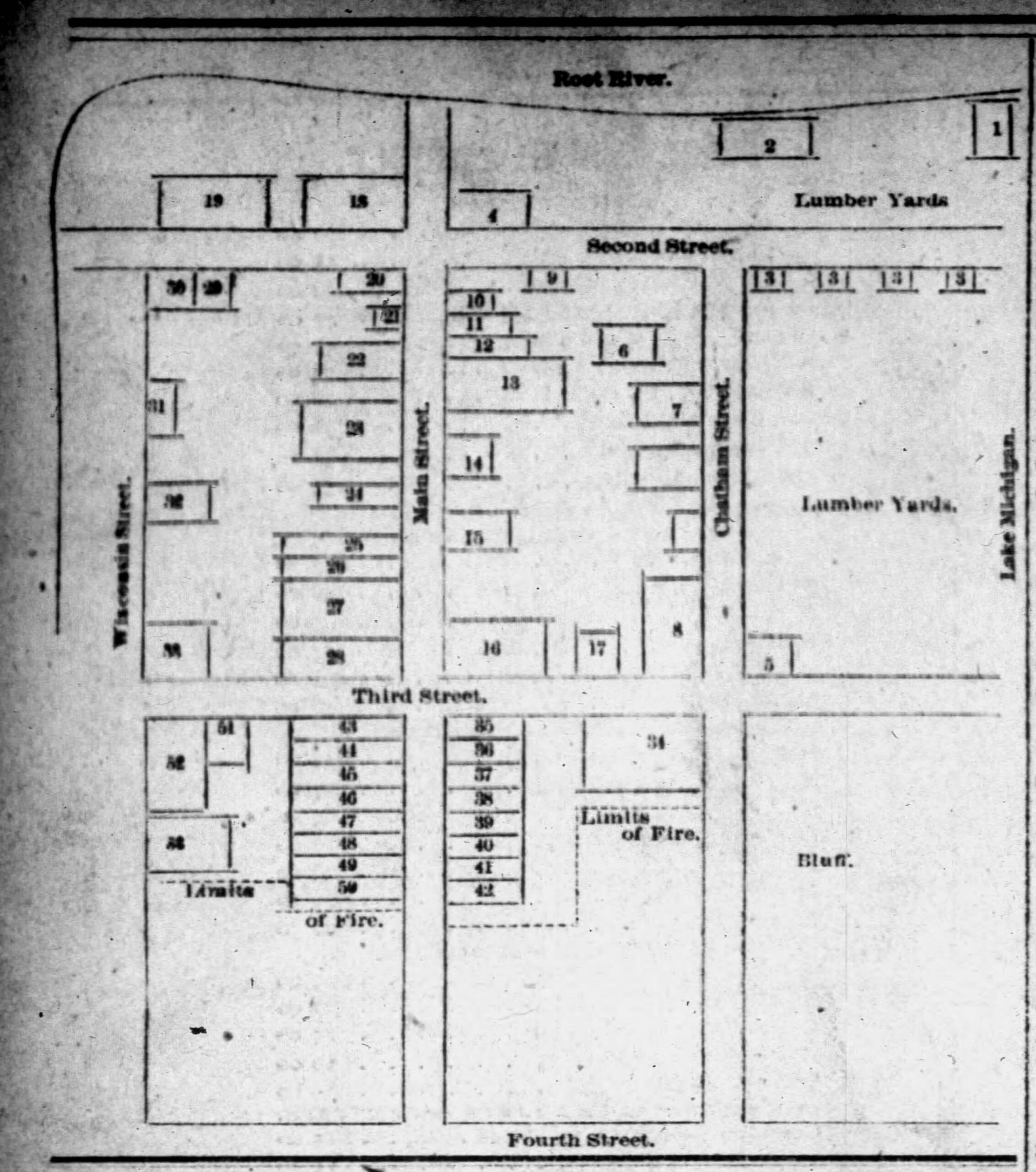
Index to the map of the Racine fire of May 5, 1882
Racine Daily Journal, May 6, 1882
- Goodrich Warehouse.
- Elevator.
- Lumber Offices.
- Silver Plate Factory.
- Frame Building.
- Philbrook’s Shoe Pac Factory.
- Boarding House.
- S. Miller & Co.
- Frame Dwelling.
- Denton’s Paint Shop.
- Engine House No. 2.
- Marble Hall.
- F. Ibling.
- S. Ryan.
- Frame Boarding House.
- Railroad Offices.
- Porter’s Cabinet Shop.
- Herzog & Roberts’ Flour Mill.
- Thos. Driver’s Planing Mill.
- Klapperth Shoe Store.
- Sam Hood’s Office.
- Farmers Home.
- Union Hall Block.
- F. X. Haas’ grocery.
- Hanson’s saloon.
- M. Keldel’s clothing store.
- W. A. Porter’s furniture store.
- F. Baumann’s hardware store.
- Tony Duffy’s saloon.
- Cary’s saloon.
- Frame dwelling houses.
- Brick dwelling.
- Frank Wright’s livery stables.
- Congress Hall.
- Kelley’s harness shop.
- Saloon.
- Sewing machine depot.
- Bakery.
- Mrs. Atkinson, millinery.
- Sutherland’s harness shop.
- Kammerer’s barber shop.
- Summer Garden.
- Schulze’s Drug Store.
- Heck’s Saloon.
- Havek’s Grocery Store.
- E. H. Brill Grocery Store.
- A. Kraupa’s Hardware Store.
- Kock’s Saloon.
- Hagen & Benning’s shoe store.
- Oslus, Hettrich & Co., dry goods.
- Frame dwelling house.
- Chas. Troy’s boarding house.
- Brick dwelling houses.
Racine Daily Journal
Saturday Afternoon, May 6, 1882
FIERY CHAOS!
A Destructive Conflagration Which Sweeps Over Seven Blocks, And Destroys 44 Buildings and Ten Million Feet of Lumber.
Detailed Statement of Individual Losses and Insurance.
The Former Aggregating $700,000, and the Latter $250,000.
Unprecedented Scene of Excitement.
Incidents of a Memorable Night.
Racine has experienced the heaviest calamity that ever came upon it, and we may say with truth, a disaster such as a city of equal resources has seldom been called upon to meet. A conflagration involving a loss of at least one million dollars, or one-eighth of the assessed valuation, the total loss of a very large part of its great lumber interests, the destruction of a large growing and most promising manufacture, and the loss of that which can never be replaced—the families of a city of 20,000 people—a calamity that can scarcely be overestimated. Oshkosh has perhaps suffered a larger loss in time past, but with that exception we do not recall a city of the same class which has fallen into such misfortune.
At ten o’clock Friday night, many citizens who had occasion to be out noticed the smell of smoke in the atmosphere; a few were convinced that a fire was smoldering in some quarter of the city. Some thought it was a fire at the brickyards south of the Point, but the majority did not even attempt to locate the source of the smoke. There was a fire at the brickyards, but it was clearly not the origin of what was unmistakably the first manifestation of the great disaster.
Before they could turn their stream on the burning building it was already in flames which leaped high in the air and illuminated the atmosphere as with fiery meteors shooting athwart the sky. By this time hundreds of people had gathered and the entire population of the city was rapidly moving towards the harbor. The engines were useless. Work as they might they could not subdue the flames which quickly spread to the adjacent lumber piles. The old wooden building occupied by the Goodrich Company was dry as a match, and stored with inflammable material, burned furious and fast. It was quickly perceived by the firemen that the huge ten-story elevator, one hundred and fifty feet high, and situated not more than 250 feet from the warehouse, was in imminent danger.
The gale blowing from the east carried flaming sparks and blazing shingles against the elevator. The glass was broken from some of the upper windows, and through these poured a shower of sparks. Above the lower part, which was sheeted with iron, rose a smaller superstructure of wood, and upon this lodged burning, flying sparks which clung to the doomed building like a child to its mother. First a burning speck was seen and then a tiny blaze. Another and another appeared. The firemen turned from the blazing lumber piles and struggled up the iron stairway which encircled the elevator, lugging the heavy hose with them. They reached the platform at the head of the stairway and turned a stream upon the three little patches of fire. It seemed for a moment that the fire might be subdued and the elevator saved, when suddenly it was seen to be all ablaze inside. The sparks which had blown in through the broken windows had kindled a flame which
NO POWER ON EARTH
could subdue. Nothing daunted, the brave firemen burst open the iron door eighty feet above the ground and literally forced their way into the building. Divided into small compartments and filled with an inflammable, impalpable dust, the flames spread like lightning. It was useless to contend with them, and the powerless firemen sought safety in retreat.
Baffled in the endeavor to save the elevator, the department turned to the work of checking the conflagration the best it could reach the Silver Plate Works, located at the northeast corner of Main and Second streets. The elevator had become a second sun of seething flames which shot high in the sky and lighted the entire city, almost with the light of day. Its brilliancy awakened all who had slumbered hitherto, and thousands upon thousands crowded the streets leading to the scene of the conflagration. By this time, 11:30, all the railroads were aroused to the magnitude of the danger threatening the community, and dispatched messages to Milwaukee, Chicago and Kenosha begging that all the fire engines available be instantly sent to the relief of the burning city. Responses of immediate assistance were returned. Millions of sparks were being carried by the fierce wind to the west of the river, and it seemed almost certain that some of them must ignite the lumber and wood yards of the Case Threshing Machine Company.
The hoarse whistles of that factory and the others lying in the path of the shower of sparks blew frantically, calling the men to the protection of the factories. They responded promptly, and in less time than it takes to tell, streams of water were poured over the endangered shops. Half a dozen tugs were at work in the river between Main street bridge and the Goodrich dock when the fire began, which were in imminent danger of being consumed, but they were towed hastily from their moorings. All the vessels were towed to the south of the river and then they rocked at the mercy of the heavy sea.
THE ORIGIN.
The fury of the winds carried the burning brands and piles of the elevator to the warehouse. It is said by those who witnessed that nothing short of a miracle could save the buildings on Case / Chatham street.
The lumber offices caught and succumbed to the fiery flood. From thence to the large brick boarding house owned by the Moore estate was but a short step. It was, and a small frame house served as further food, and then came the handsome brick factory of J. Miller & Co., on the corner of Chatham and Third streets. The flames swept through the building with astonishing rapidity, and bursting through the front leaped heavenward as if in exaltation of their fiendish work. And this morning all that remains of what but a few short hours before was a hive of industry, is a heap of ruins, ashes and crumbling masonry.
Directly opposite was situated Congress Hall, owned by Seneca Raymond. The guests had barely time to pack their personal effects and make their escape, when this, too, was attacked by the insatiable element, and this popular caravansary was added to the disaster.
Here the fire received its first check, and hope began to dawn that the balance of the street could be saved. The next building to Congress Hall had its windows covered with sheet iron, and a large band of men determined that all human effort should be made to cheat the fire of its prey, and save the remaining residences and the large new building of M. M. Secor. Success crowned their endeavor and the glad word was passed through the dense crowd that at last further devastation in this direction was stayed.
COURSE OF THE FIRE.
The JOURNAL reporter was one of the first persons on the ground, and when he arrived on the scene, nothing but smoke could be seen issuing from the Goodrich freight house, but the terrific northeast gale soon fanned the fire and in a few minutes the whole structure was in flames which rapidly spread to the lumber yard of Jones, Knapp & Co., thence to the lumber yards of Kelly, Weeks and Co. Masses of sparks were blown hither and thither, and some of them found their way into the large elevator of the Chicago, Milwaukee and St. Paul Railroad, through broken windows.
Everything being dry in that structure it was only a few moments before it was a mass of fire; from here it spread to the slat sheds of the Racine Warehouse and Dock Co., thence to the Silver Plate Co. Here it jumped across Second street to Michael Hartnetter’s house, thence to the No. 3 Engine house; thence to the Marble Hall, Ibling’s furniture store, and Ryan’s harness shop. The flames also spread up Chatham, burning the lumber office of S. Miller & Co.’s office, Philbrook & Co.’s shoe pac factory, the Lake House, and a dwelling house of James Walker; it swept along taking in its embrace Herzog & Roberts’ mill; then across Second street to the lumber piles of Driver & Son; thence to Hood’s office; Driver & Son’s store house; Kosterman’s brick building; Anthony Hayek’s barn; then to Peter Mack’s house on Wisconsin street; then Klapporth’s building; the Farmer’s Home; Union Hall block; Kinahan’s store; F. X. Haas’; A. Hayek’s brick building; Keldel’s clothing store. On Wisconsin street it leaped across taking several dwellings adjoining Howe’s house; Porter’s Cabinet shop; to Boutwell House; then to a brick building of Thomas Davis and a brick dwelling. The treacherous flames ran along the lumber piles on the lake shore, and the flames were blown against J. Miller & Co.’s boot and shoe factory and what was soon a mass of flames; then the wooden buildings between that and the Case Threshing; then the flames leapt across Third street to Congress Hall; next the elegant Railroad building caught and a few moments was a roaring sea of fire; next the Congress Hall barn went; then two wooden buildings on the corner of Second and Main; from here it went south, sweeping the old Hogan building, Steckler’s bakery, Singer Sewing Machine office, Mrs. Atkinson’s millinery store, Sutherland’s harness shop; several of Chas. Paul’s buildings; Kammerer’s barber shop, and Chas. Roth’s summer garden. The flames leaped across to the west side of Main, destroying J. Heck’s saloon, A. Hayek’s grocery store, Kraupa’s hardware store, Brill’s grocery store, John Koch’s saloon, Hagen & Benning’s shoe store, and a large number of other buildings were damaged.
SCENES.
As the elevator fell in, the four-story factory of the Silver Plate Company was seen to be on fire, and effective measures were directed to saving the property on the west of Main street, consisting of the Star Flouring Mills, owned by Herzog & Roberts, and the planing mills of Driver & Son. In spite of all efforts the fire leaped across Main street, and the flouring mills were quickly wrapped in a mass of flames. The fine structure which, but a few months since, had been fitted with first-class machinery grinding by the roller process, was doomed, and the attempt to save it was given up in despair. A number of men stood their ground manfully, battling for the salvation of the Driver planing mill, not more than fifty feet from the flouring mill. By some strange freak of the fire demon the planing mill was spared. Surrounded as it was with dry and combustible material, it was still a mystery how it could have escaped. Other buildings far less subject to destruction by fire fell, one after another, while this one was equally exposed.
Striking on the north side of Third St. the building occupied by Tony Duffy as a saloon was equally gutted. The brick building occupied by F. A. Ketz, situated scarcely 10 feet from Duffy’s, escaped unscathed. From thence the fire rapidly spread to the south until it was stopped about half way between Third and Fourth.
At 11:30 it was reported that the Milwaukee engines had arrived and were playing on the fire. The report was false, but was revived with every assurance of deliverance at intervals of half an hour. Not until 3 o’clock, after repeated messages of urgency had been forwarded, did a Milwaukee special bringing three steamers to the rescue roll into the depot. Arriving there the engines were quickly unloaded, the horses hitched and sent clattering to the scene of action. The three magnificent steamers sent to the rescue by the generous sympathy of Milwaukee were stationed on Third street with the firemen midway between that and Second street. From the moment of their appearance upon the scene the aspect of affairs changed for the better. The firemen who had thought the entire business quarter of the city as far as Market Square gone, and as much further as fate should determine, was doomed. The northeast wind was driving the flames straight upon the best part of the city. The Racine firemen were fighting with their five hours’ fight and seemed powerless to contend with the flames. With the coming of the Milwaukee firemen a new hope seemed to dawn. Their powerful engines and fresh men might be able to cope with the destroying element. They proved to be worthy of their reputation and the hope their coming inspired. They grappled with the conflagration like men conscious of strength. Planting their ladders upon the building next north of Oslus & Hettrich’s three-story brick building they mounted to its blazing roof and faced the blasts of flame, while they threw great streams of water upon that and the crumbling frame building to the north. The work told in a speedy manner, and in half an hour the safety of the city was assured. The fire was checked and that remaining to play upon the buildings already burning. Milwaukee saved the city from a calamity ten fold worse than the one suffered.
CHICAGO ENGINES.
Two engines left Chicago and arrived in Racine about 6:15. They were immediately put at work on Wisconsin street where magnificent service was done in the protection of the Oil Mill and the dwellings on the side of the street. That service was not so valuable for the buildings directly saved as for the danger thus warded from the wooden mills of Dickey & Pease and Case & Co. Their work was thus of immense service and fully appreciated by the people. At two o’clock this afternoon the steamers were still playing on the smoking ruins which extend over an area of about seven blocks in extent and present a sight that needs to be seen to be fully appreciated. They tell a tale more eloquent than words of the misery entailed by last night’s conflagration.
DAMAGE AND INSURANCE.
The Goodrich warehouse, where the conflagration started, was valued at $4,000 but it is not known whether there is any insurance on the structure or not. A large quantity of flour, feed and salt was in the house, belonging to G. W. Scanlan, the agent of the Goodrich Transportation Co., on which there was insurance of $1,250 in the Underwriters’. C. 3,000 barrels of salt owned by Scanlan and damaged, was insured for $4,500. F. Rothfield had considerable hay in the place; the Racine Jacket Factory, five or six hundred jackets; M. M. Secor, trunks, and G. W. Slauson 10,000 strawberry crates, all of which was consumed and is a total loss, there being no insurance. The total amount of all freight burned will reach $5,000. All valuable papers of the steamboat company were saved.
JONES, KNAPP & CO.
This firm estimate their loss at $73,000, with the following insurance:
| Company | Amount |
|---|---|
| Connecticut Fire | $2,000 |
| Rhode Island Underwriters Asso. | $2,000 |
| Underwriters | $2,000 |
| Springfield Mass. | $2,000 |
| Continental | $2,000 |
| Queen | $2,000 |
| North British, Mercantile | $2,000 |
| American, Newark | $2,350 |
| Niagara, N.Y. | $2,000 |
| Royal, Liverpool | $2,000 |
| Lancashire | $2,000 |
| Total | $20,350 |
KELLY, WEEKS & CO.
The above named firm lose in the neighborhood of $65,000, and have the following insurance in different companies:
| Company | Amount |
|---|---|
| Imperial of London | $3,000 |
| American, Phila. | $2,500 |
| Fire Association, Phila. | $2,500 |
| Lancashire | $2,000 |
| Phoenix, Hartford | $4,000 |
| Hartford Fire | $2,500 |
| North-western, Nat. | $2,000 |
| Hartford Fire | $2,000 |
| Merchants, Newark | $1,000 |
| Westchester, N.Y. | $2,000 |
| Continental, N.Y. | $2,000 |
| London Globe, Liverpool | $6,000 |
| Total | $31,000 |
SILVER PLATE CO.
What is lost to this company can not be exactly ascertained as a large amount of valuable property was in the vault, and if that is safe, the loss will not foot up so large, but if destroyed it will reach $70,000. The insurance on buildings and stock, in companies, is as follows:
| Company | Amount |
|---|---|
| Liverpool and London Globe | $5,000 |
| Royal, of Liverpool | $2,500 |
| Phenix of Hartford, Conn. | $2,000 |
| Springfield, Mass. | $2,000 |
| Buffalo, N.Y. | $1,000 |
| Glen’s Falls, N.Y. | $2,000 |
| Commercial Union, London | $2,000 |
| Fire Association, Phil. | $2,000 |
| Northern National Wis. | $1,000 |
| Westchester, N.Y. | $1,000 |
| Watertown, N.Y. | $1,000 |
| Commercial Union, London | $2,000 |
Continued on First Page.